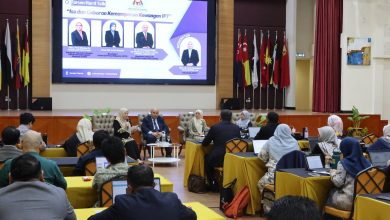

PUTRAJAYA, 20 January 2026: The Ministry of Higher Education (MoHE) has outlined the year 2026 as a phase of leadership maturity, one that requires discipline in implementation, decisiveness in policymaking, and a strong sense of accountability in strengthening Malaysia’s higher education ecosystem.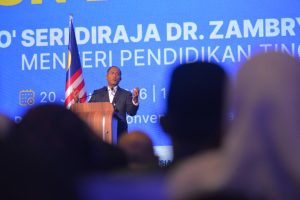
Minister of Higher Education, Dato’ Seri Dr Zambry Abdul Kadir emphasised that the 2026 Address marks a shift away from the generation of new ideas towards the rigorous and high-impact of execution of existing policies. This direction, according to him, aligns with MoHE’s aspiration to become an “Akal Budi Nusa” that is a national centre for the synthesis of knowledge and civilization that balances intellectual intelligence with noble character.
According to him, universities must transcend their conventional roles as producers of knowledge and skilled manpower, and instead function as agents of change and nation-builders that bridge tradition and transformation, as well as idealism and the realities of life.
Reflecting on the three-year journey of leadership, he noted MoHE has undergone an evolution of awareness, shaped by a deeper understanding of the changing times, human development and leadership trust.
The 2024 Address focused on navigating the challenges of a post-normal world, while the 2025 Address examined the crisis of meaning and generational transition in the era of artificial intelligence (AI). The 2026 Address, he said represents a decisive transition into a phase of comprehensive and disciplined implementation.
He highlighted several notable achievements recorded in 2025, including the organisation of the Putrajaya Festival of Ideas (FOI), the MADANI Scholars Forum, the rollout of the SULUNG Programme, the recognition of five public universities listed among the top 10 universities in ASEAN, and the strengthening of Malaysia’s position as a Global Education Hub.
Moreover, Dr Zambry acknowledged a range of emerging issues that require holistic and sustained attention. These included public perception of fairness in the university admission system, the graduate employability, funding and allocation constraints, governance issues, the persistence of toxic culture in institutions and the evolving challenges of university rankings within the new liberal economic framework.
To address these concerns, the 2026 Address outlines seven main thrusts and ten strategic agendas, including the implementation of the Malaysian Higher Education Plan (RPTM) 2026–2035 as a living document. The framework is grounded in a collaborative, human-centred, and nation-building approach to higher education development.
Also emphasised were the expanded roles of academia as a nation-builder, the welfare and development of students through the introduction of Academic Bank Credits (ABC); more agile and responsive university governance; the empowerment of POLYCC as a leader in technical and professional education; the strengthening alumni networks through the Alumni Back to Campus initiative; and the positioning of AI as the key enabler of higher education transformation.
In concluding the address, he called on all higher education professionals to embrace new ways of working that emphasise reducing complexity, accelerating implementation, and prioritising impact, in order to realise the collective aspiration of making Malaysian higher education a cornerstone of Akal Budi Nusa.
Also present at the event were the Chairman of the Board of Directors of UUM, Tan Sri Dr Mazlan Yusoff; UUM Vice-Chancellor, Prof. Dr Ahmad Martadha Mohamed and deputy vice-chancellors and members of the UUM Student Representative Council.