
News and photos Dr. Low Kah Choon
SINTOK, 24 December 2025: The Institute of Local Government Studies (iLGS), School of Government (SoG), Universiti Utara Malaysia (UUM), in collaboration with the Japan Council of Local Authorities for International Relations (J.CLAIR) Singapore, successfully organised the Local Government Talk: Best Practices of Local Governments in Malaysia and Japan at the SMMTC Seminar Hall, UUM.
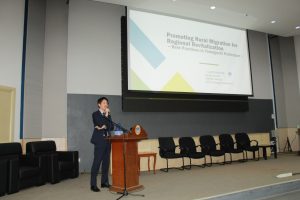
The half-day programme brought together 60 participants comprising UUM students and academic staff, Japanese local government officers, researchers, and international practitioners, reflecting strong interest in comparative and practice-oriented approaches to local governance.
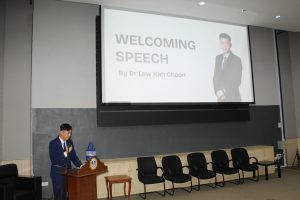
The programme commenced with a welcoming address by the Programme Director, Dr Low Kah Choon, Senior Lecturer at SoG and Research Fellow at iLGS. In his remarks, he underscored the strategic importance of sustained knowledge exchange between academia and practitioners. He emphasised that the programme was conceived not merely as an academic forum, but as a platform for sharing best practices with tangible real-world impact. Dr Low also highlighted the role of universities in supporting evidence-based policymaking, institutional capacity building, and continuous learning for local authorities.
This was followed by a presentation by Mr. Takano Kazuki, Executive Director of J.CLAIR Singapore, who introduced the mandate and core functions of the organisation. He explained that J.CLAIR was jointly established by Japanese local governments to promote international cooperation at the subnational level, particularly within Southeast Asia.
Mr. Takano noted that J.CLAIR Singapore serves as a bridge between Japanese municipalities and their regional counterparts by facilitating practical cooperation, policy learning, and long-term partnerships grounded in local needs. He further highlighted that J.CLAIR’s work extends beyond exchanges to include applied research, policy dialogue, and technical support to enable municipalities to learn from one another’s experiences.
The practitioner segment of the programme featured four case studies presented by Deputy Directors of J.CLAIR Singapore, each highlighting distinctive and innovative local government practices from Japan. Mr Fukuyama Koki shared the experience of Osaki Town in Kagoshima Prefecture, where an intensive community-based waste separation system and close collaboration among residents, the local council and private recyclers have achieved exceptionally high recycling rates and a significant reduction in landfill waste.
Ms Yoshioka Yurie presented Tokyo Green Biz, a long-term green urban development initiative designed to guide Tokyo’s environmental sustainability over the next 100 years through the integration of green infrastructure, climate resilience, and urban liveability. Ms Ueda Yoshimi introduced the concept of Region Management Organisations (RMOs) through the case of Uozu City, illustrating how resident-led organisations complement municipal services by strengthening social cohesion, disaster preparedness and local economic activities.
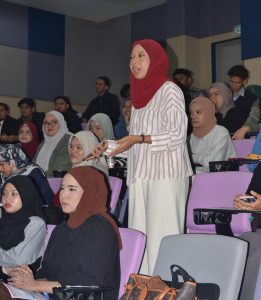
Mr Kimura Akinobu concluded the Japanese segment by outlining Yamaguchi Prefecture’s strategies to promote rural migration and regional revitalisation through relocation incentives, teleworking facilities, trial housing, and migrant support centres. A panel discussion moderated by Dr Muhammad Hafiz Abd Razak followed, providing an interactive platform for dialogue and a question-and-answer session between participants and the representatives from J.CLAIR Singapore.
Complementing the Japanese practitioner perspectives, three academics from the School of Government, UUM, presented research findings grounded in Malaysian local government contexts. Each presentation was followed by a question-and-answer session.
Dr Low Kah Choon examined training implementation and effectiveness among Cameron Highlands District Council employees, highlighting the need for more targeted, job-specific training aligned with departmental functions. Dr Nor Suzylah Sohaimi addressed issues of urban poverty and housing affordability, focusing on local government interventions for B40 communities, including affordable rental housing and policy instruments aimed at ensuring long-term housing security. Dr Muhammad Hafiz Abd Razak analysed the architectural conservation and tourism-led adaptive reuse of historic godowns in Melaka, emphasising the role of local government policies in balancing heritage preservation with economic development and tourism pressures.
The organiser also expressed their appreciation for Mr Siau Min Yang, Senior Researcher of J.CLAIR Singapore, who played a central role in the successful implementation of the programme through close coordination with the Programme Secretariat at UUM. His efforts in facilitating communication, coordinating speakers, and aligning programme objectives were instrumental in ensuring the smooth execution and substantive quality of the programme. The collaboration was cited as an example of effective behind-the-scenes partnership translating international cooperation into concrete academic and policy engagement.
Overall, the Local Government Talk strengthened academic–practitioner collaboration between Japan and Malaysia and provided participants with actionable insights into innovative, people-centred and sustainable approaches to local governance. The organisers expressed hope that the ideas shared would inform future research, teaching, pilot initiatives, and policy development among Malaysian local authorities, while also paving the way for continued collaboration with J.CLAIR Singapore.