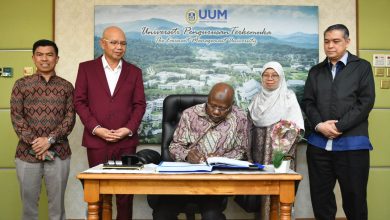

UUM Receives PMKS Entrepreneur Development Blueprint and Sabah Halal Action Plan 2.0 (2026–2028)

SINTOK, 4 February 2026: The Vice-Chancellor of Universiti Utara Malaysia (UUM) recently received the Micro, Small and Medium Enterprise (PMKS) Entrepreneur Development Blueprint and the Sabah Halal Action Plan 2.0 (2026–2028). The documents were formerly presented by the Chairman of the MUIS Halal Hub, the Sabah Islamic Religious Council (MUIS), during a session held at EDC-UUM on 1 February.
The handover of these documents underscores UUM’s continued commitment to strengthening the entrepreneurial and halal ecosystems through knowledge-driven initiatives, integrity-based governance, and community empowerment. The collaboration is particularly significant for advancing the development of PMKS in Sabah and enhancing their competitiveness at the national level.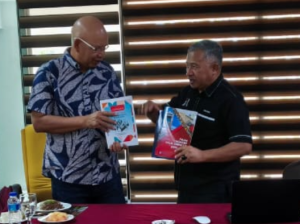
Vice-Chancellor, Prof. Dr Ahmad Martadha Mohamed expressed his appreciation for the confidence placed in UUM by the Sabah Islamic Religious Council to serve as a strategic partner in fostering an inclusive economy and advancing the halal industry.
According to him, UUM is fully prepared to leverage its academic expertise, applied research capabilities, and industry networks to support the effective implementation of both the blueprint and action plan through professional training programmes, entrepreneurial mentoring, technology transfer and systematic impact monitoring.
“This collaboration is expected to open up wider collaboration avenues for partnerships, particularly in joint research, the development of training modules, incubation programmes and the strengthening of the University Halal Hub as a reference centre and catalyst for the growth of PMKS,” he said.
Meanwhile, the Chairman of MUIS Halal Hub, Mr Muhammad Sidik bin Awang Adi, explained that the Sabah Halal Action Plan 2.0 (2026–2028) has been carefully designed to reinforce the overall halal value chain in Sabah. The plan encompasses areas such as halal certification, regulatory compliance, entrepreneur capacity development, market access and digital transformation.
He further highlighted that the initiative is also aligned with the aspirations of sustainable development and socio-economic inclusion.
With the acceptance of the blueprint and action plan, UUM further consolidates its role as an impact-driven university that actively contributes to national priorities in economic development, entrepreneurship and the advancement of the halal industry.
The handover ceremony was also witnessed by members of the research team from the School of Government, UUM.