
UUM Strengthens Transformation Agenda through Six Strategic Thrusts, Driving Global Reputation and Institutional Sustainability

SINTOK, 8 July 2026: Universiti Utara Malaysia (UUM) continues to strengthen its institutional transformation agenda through the implementation of the Phase IV Strategic Plan (2026-2030), which emphasises academic excellence, internationalisation, impactful research, student development, financial sustainability, leadership excellence, and effective governance to ensure the university remains relevant and competitive at both the national and international levels.
Vice-Chancellor, Professor Dr Ahmad Martadha Mohamed said that the strategic plan serves as a comprehensive guide for all schools, departments and centres of authority (PTJs) in formulating strategic initiatives and achieving the targets set in line with the university’s vision of becoming a leading management university.
According to him, although the university’s vision is currently undergoing a review process by the University Board of Directors (LPU) and other key stakeholders, its overarching aspiration continues to guide the university’s strategic direction.
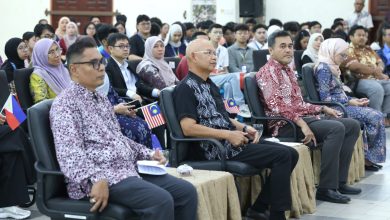
“We want UUM to continue to be a university of reference in the field of management, not only in Malaysia but also globally,” he said at the Strategic Plan Appreciation Ceremony and Presentation of the Second Quarter Achievements of the 2026 Strategic Plan at EDC-UUM, today.
He added that the university’s mission of educating leaders with holistic character who are committed to serving the global community continues to underpin every initiative undertaken, in line with the University’s long-standing aspiration to strengthen its international presence.
To realise this aspiration, the university has identified six strategic thrusts, namely enhancing academic excellence and global influence; leveraging research, innovation, commercialisation, and entrepreneurship for societal well-being; nurturing students with exemplary character and values; strengthening a new model of financial sustainability; reinforcing institutional leadership excellence; and upholding good governance while enhancing service delivery.
Professor Ahmad Martadha explained that every research outcome should generate tangible benefits for society and industry through innovation and commercialisation, rather than merely being published in academic journals or archived as a research report.
In terms of student development, he stressed that UUM remains committed to producing graduates who not only excel academically but also possess exemplary character, sound values, leadership qualities, and commendable manners, in line with the university’s educational aspirations.
At the same time, he said the university would continue to strengthen its financial sustainability by exploring new sources of income, expanding strategic partnerships with industry, and enhancing income-generating initiatives to reduce its dependence on government funding.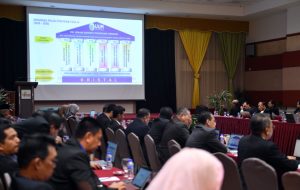
He also reminded leaders at the school and centres of authority levels to play a more proactive role in enhancing graduate employability through stronger strategic collaborations with industry partners and prospective employers.
Commenting on the university’s reputation, he said that every member of the university community has a shared responsibility to safeguard UUM’s good name amid increasing public scrutiny of higher education institutions.
According to him, although the university has provided clarification on several issues related to open-channel admissions and the recruitment of international students, protecting the university’s reputation cannot rest solely with the management.
Instead, he urged all staff to contribute through various platforms, including social media, professional writing, knowledge-sharing activities, and professional networks to ensure that accurate information about the university is effectively communicated to the public.
He also encouraged academics to enhance the visibility of their scholarship through contributions to the mass media, active participation in professional organisations, involvement in national and international committees and engagement with global academic networks. He noted that such efforts should also be regarded as an important element in career development and promotion.
Professor Ahmad Martadha said that enhancing the university’s academic reputation has a direct impact on its standing in international rankings, thus influencing the confidence of prospective students, particularly international students, in choosing UUM as their preferred study destination.
As part of its efforts to expand the international education market, UUM also plans to introduce the Foundation in English Programme in China as an entry pathway for international students to pursue their studies at the university.
In addition, UUM Kuala Lumpur Campus will be further strengthened as a satellite campus by offering a wider range of undergraduate and postgraduate programmes, while serving as a more active hub for student recruitment and promotional activities.
He noted that many public universities are expanding their presence in Kuala Lumpur and emphasised that UUM must fully leverage its existing facilities and strategic location to enhance the competitiveness of the institution.
On administrative matters, he informed that the approval process for Memoranda of Understanding (MoUs) can now be expedited following the delegation of certain approval powers to the University Board of Directors (LPU). The move has reduced administrative bureaucracy and accelerated the implementation of strategic collaborations.
He also highlighted several of the university’s recent achievements, including the recruitment of the first cohort of 96 Administrative and Diplomatic Officer (PTD) cadets to pursue master’s degree programmes at UUM, as well as the successful collaboration with the Institute of Diplomacy and Foreign Relations (IDFR), which attracted encouraging participation from postgraduate students.
According to him, efforts to attract more postgraduate and international students will continue to be intensified, as both groups remain among the university’s main contributors to financial sustainability.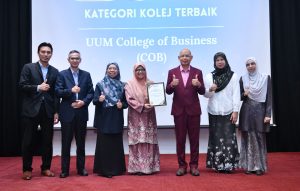
In the meantime, he said UUM continues to engage actively with ministries, government agencies, and industry partners to enhance graduate employability and ensure that its academic programmes remain aligned with the evolving needs of the job market.
Among the initiatives currently being prioritised are expanding employment opportunities for accounting graduates within the public sector, strengthening professional certification components across academic programmes, and introducing more Open and Distance Learning (ODL) programmes to meet the growing demand for flexible learning opportunities.
Professor Ahmad Martadha also reminded all members of the university community to uphold a work culture based on UUM’s shared KRISTAL values, namely commitment, responsiveness, accountability, integrity, synergy, and sustainability, in every action and decision undertaken.
He stressed that every leader must honour the trust placed upon them and leave behind a meaningful legacy that can be continued by future leaders, thereby ensuring the continuity of the university’s transformation agenda.
To ensure the effective implementation of each strategic thrust, responsibility for driving the six thrusts has been entrusted to members of the university’s top management according to their respective portfolios and areas of expertise. In addition, the university has enhanced its performance monitoring system by adopting a more rigorous and impact-oriented assessment approach.
The Vice-Chancellor said that the university no longer intends to set key performance indicators (KPIs) that are easily attainable. Instead, each target should be sufficiently challenging to drive continuous performance improvement, innovation and institutional excellence.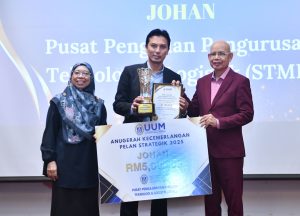
As of the second quarter of 2026, the UUM Strategic Plan recorded an achievement of 77.6 per cent, with 69 out of 143 key performance indicators (48 per cent) having fully achieved their respective targets.
He explained that several key indicators will only be assessed during the second half of this year and are expected to further improve the University’s overall performance by year-end.
Concluding his address, Professor Ahmad Martadha called upon all members of the UUM community to continue fostering a spirit of togetherness, embrace challenges beyond their comfort zones, support one another, and play their respective roles in realising the university’s transformation agenda to enable UUM to further strengthen its position as a leading management university that is respected both nationally and internationally.
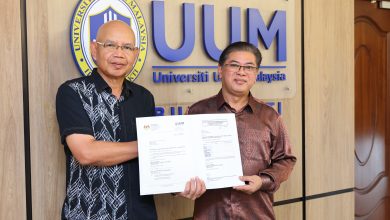
The event also featured the UUM 2026 Strategic Plan Appreciation Ceremony, during which 49 awards were presented in recognition of outstanding achievements. Letters of appointment were also presented to the six strategic thrust leaders.