
UUM Islamic Business School Senior Lecturer delivers second Islamic Finance guest lecture at BRN Bank in Tashkent

News and photos Dr. Amirul Faiz Osman
TASHKENT, 20 May 2026: Senior Lecturer at UUM Islamic Business School (UUM IBS), Dr. Amirul Faiz bin Osman, was recently invited to deliver a guest lecture on Islamic finance at BRN Bank. The lecture, entitled “Islamic Finance Development and Opportunities: Lessons from Malaysia for Uzbekistan’s Banking Sector,” served as an important platform for academic-industry knowledge sharing in the field of Islamic banking and finance.
The engagement marked the second guest lecture delivered by Dr. Amirul during his academic visit to Uzbekistan. The visit forms part of his role as a Visiting Lecturer under the initiative of the Center for International Affairs and Cooperation (CIAC), Universiti Utara Malaysia (UUM), in collaboration with TIFT University, University of Financial Management and Technology, Tashkent, Uzbekistan.

As one of the banking institutions in Tashkent, BRN Bank provided a strategic industry platform for discussions on Islamic finance, particularly as Uzbekistan continues to explore the potential of integrating Islamic financial principles into its banking sector. The session enabled participants to examine how Islamic finance principles, banking products and institutional practices can contribute towards ethical, inclusive and real-sector-oriented financial development.
Among the key areas highlighted during the lecture were the importance of establishing a clear legal and regulatory framework, strengthening Shariah governance, developing competent Islamic banking talent, ensuring product transparency, and linking Islamic finance to the real economy. Dr. Amirul also discussed the relevance and practical application of several Islamic finance contracts and instruments, including murabahah, ijarah, mudarabah, musharakah, wakalah and sukuk.
He further emphasised that Islamic finance should not merely be viewed as a faith-based alternative to conventional banking. Instead, he explained that it represents an ethical, transparent and asset-backed financial system that promotes fairness, financial inclusion, risk-sharing and sustainable economic development.
The participants demonstrated strong interest throughout the session and actively engaged in the discussion. Following the lecture, participants raised several questions regarding current Islamic finance practices, the practical implementation of Islamic banking products, Shariah governance arrangements, and the suitability of Malaysia’s experience for Uzbekistan’s banking landscape.
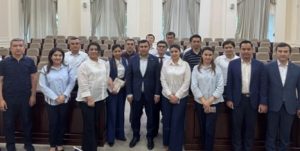
The discussion also extended to opportunities for further studies in Islamic finance at UUM, reflecting participants’ growing interest in strengthening their professional and academic understanding of the field. Dr. Amirul shared insights into UUM’s academic expertise in Islamic finance and highlighted the potential for future learning, research, and professional collaboration between Malaysian and Uzbek institutions.
In his concluding remarks, Dr. Amirul stated that Malaysia’s Islamic finance experience could serve as a valuable reference for Uzbekistan, while emphasising that any implementation should be carefully adapted to the country’s legal, economic, regulatory and cultural contexts.
“Malaysia’s experience shows that Islamic finance requires more than products. It requires a complete ecosystem built on trust, governance, Shariah credibility, talent development and real economic impact.”
The guest lecture further strengthened UUM’s international visibility and reaffirmed the role of UUM Islamic Business School as an important contributor to Islamic finance education, research, and industry engagement at the global level.