
UUM Islamic Business School senior lecturer shares Malaysia’s Islamic Finance Experience with SQB Bank

Prepared by Dr. Amirul Faiz Osman
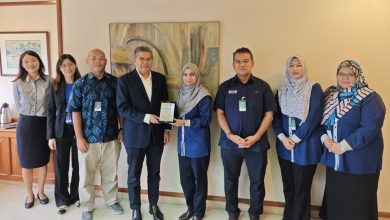
TASHKENT, 17 May 2026: Senior Lecturer at the UUM Islamic Business School (UUM IBS), Dr. Amirul Faiz Osman, was recently invited to deliver a guest lecture at SQB Bank, Uzbekistan, entitled “Malaysia’s Islamic Finance Growth: Lessons and Strategic Opportunities for Uzbekistan’s Banking Sector.”
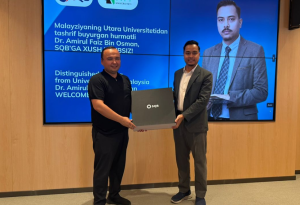
The lecture was held as part of Dr. Amirul’s engagement as a Visiting Lecturer under the initiative led by the Centre for International Affairs and Cooperation (CIAC), Universiti Utara Malaysia (UUM), in collaboration with TIFT University and University of Financial Management and Technology, Tashkent, Uzbekistan. The programme reflects UUM’s continuous commitment to strengthening international academic collaboration and expanding global knowledge-sharing initiatives in Islamic banking and finance.
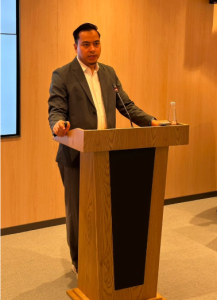
SQB Bank, also known as the Uzbek Industrial and Construction Bank, is among Uzbekistan’s leading financial institutions and plays a significant role in supporting the country’s economic development, particularly in industrial growth, construction financing, corporate banking and national infrastructure development.
During the session, Dr. Amirul shared Malaysia’s journey in developing Islamic finance from its early institutional foundations into a comprehensive and globally recognised financial ecosystem. He highlighted that Malaysia’s achievements in Islamic finance were not solely driven by the introduction of Islamic banking products, but by the establishment of a robust ecosystem supported by sound regulation, effective Shariah governance, talent development, product innovation and strong industry collaboration.
Among the key areas discussed were Malaysia’s dual banking system, the role of Bank Negara Malaysia, centralised Shariah governance, Islamic banking product development, takaful, sukuk, the Islamic capital market, and value-based intermediation.
Dr. Amirul also stressed that Islamic finance should not merely be perceived as a faith-based financial alternative but rather as an ethical, transparent and asset-backed financial system that promotes fairness, risk-sharing, financial inclusion and sustainable economic growth.
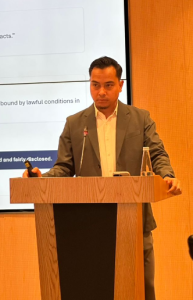
He further explained that Uzbekistan could benefit significantly from Malaysia’s experience by adopting a phased and structured approach towards Islamic finance development. Such an approach, he noted, should include the establishment of a clear legal and regulatory framework, the strengthening of Shariah governance, the development of Islamic banking talent, the introduction of suitable Islamic financial products, and ensuring that Islamic finance remains closely linked to the real economy.
The session received an encouraging response from the participants, who demonstrated strong interest in Islamic banking and finance. Discussions were highly interactive, with participants raising questions related to the practical implementation of Islamic banking instruments such as murabahah, ijarah, mudarabah, musharakah, wakalah and sukuk.
The lecture was attended by members of the senior management of SQB Bank, making the engagement both strategic and highly relevant to the future development of Islamic banking and finance in Uzbekistan.
In his concluding remarks, Dr. Amirul stated that Malaysia’s Islamic finance journey could serve as a valuable reference for Uzbekistan, while emphasising that any implementation must be carefully adapted to the country’s legal, economic, regulatory and cultural context.
“Malaysia’s experience shows that the success of Islamic finance requires more than just products. It requires a complete ecosystem built on trust, governance, regulation, Shariah credibility, talent development and real economic impact,” he said.
The guest lecture further enhanced UUM’s international visibility and reaffirmed the role of UUM Islamic Business School as a significant contributor to Islamic finance education, research and industry engagement at the global level.